It may simply be the quality of audio in the downloaded version we watched, but to my ear there’s a strange, quiet noise which pervades Marc Karlin’s 1989 Utopias. A subtle hissing plays throughout various shots, almost like the uneasy background noise from David Lynch’s Eraserhead. This subtle sounds found various different contexts. It plays over a photo of steaming pipes from Fritz Lang’s Metropolis. I first noticed it when the camera cuts from Marsha Marshall to a boiling kettle; we cut through other household tasks in close-up, feeding a fire and kneading bread, then suddenly to images of a demolition sight. Now it’s in the hiss is of the carnivorous machinery tearing down locally industry. (There’s something of Lizzie Borden’s Born in Flames in this montage.)


The sound is heard again underneath the hum of a photocyoping machine, printing of flyers protesting the murder of Saranjit Singh Atwal. It’s in the throb of robotic arms assembling cars, as well as a vacuum cleaner in a child’s bedroom.
The low susurrus which we begin to notice isn’t the sound of anything particular in the film. Instead, it’s a displaced, ghostly sound, which drifts between and around objects, places, atmospheres. The noise evokes something eerie in the sense described by Mark Fisher: something where there should be nothing, nothing where there should be something. It feels like something is missing in late Thatcherite Britain, yet the absence is blank, whispering, hard to place.
Eery images appear throughout the film. The camera drifts past boarded up houses in an outer Darfield street. It also skirts along rows of stiff chairs facing forward in an endlessly empty conference hall. We watch an anti-racism group hold a minute’s silent and protest against the murder of a local young Asian man. And a memorial for early queer advocate Edward Carptenter. We see a projection of Saturn drifting lonely in space.
And in many respects, the image of Britain it presents us with today should be eerily familiar. After a decade of Tory rule, working class communities have been dilapidated, trade unions are ailing, and political vision throughout the country is depressed. The various socialists who Karlin interviews try to cling on to their political hopes and economic analysis in the face of this draining of political culture. Karlin is exploring hope in a heartless world, and attempting still to retrieve utopian intimations from the emptiness.

Utopias is a documentary/essay film which reconsiders socialism in Karlin’s contemporary moment. Karlin combines installation art and experimental filming techniques with interviews with socialists from a range of backgrounds. The two-hour feature is divided up into episodes constructed around the interviews in episodic form. Jack Jones talks about his years of trade union experience; a group of upholsters dicuss their ongoing struggle to set up a worker’s co-op; Shulia Rowbatham reflects on the difficulty of diverse and effective political organizing. Inter-titles suggest the approach to the idea of utopia: ‘Jerusalaem’; ‘Possibilities’; ‘In there here and now’.
Between episodes, Karlin inserts exercises in his developed distinctive political art film style (found also in A Dream From the Bath). He fills various installation spaced with images and objects, which his camera then invites us to contemplate. The film opens with the camera, handheld, floating past leaves. A broken blue neon sign reading ‘PARADISE’ scrolls past. Large-scale black and white projections which show both everyday life and political struggle stand among piles of rubble and concrete pillars. We hear recordings of various posh men talk about the inevitable failures of socialism. Karlin, narrating, asks – if we are saying farewell to socialism, what are we really saying farewell to? The camera finds credit cards alongside a collection of chrome statues – a docking rig, a hospital bed, a giant excavator – lit by a neon ‘for sale’ sign.
The tableaux like this are explored throughout the film. Trade union banners are often draped around, in the same space as workers at their craft. Elsewhere, red and black flags flutter on the top of a pile of ruins in fog. A cleaning worker contemplates a table of full of plasticy, ornately iced cakes. It’s best that a viewer finds these images for themself, which can be both instructive and surreal.


Karlin sculpts carefully with time. His camera tries to both capture and unfold the political moment which it witnesses. The statues and icons which fill these installations seem dead, static, indicating a lost political attitude. Silhouttes and statues are repeated motif. Likewise, the grainy images of Lenin and various old trade unions organizers seem to relegate socialism to a fading past. When we watch welders dismantle the last remains of a Darfield factory, there is a heavy feeling of finality, a lost moment in history.
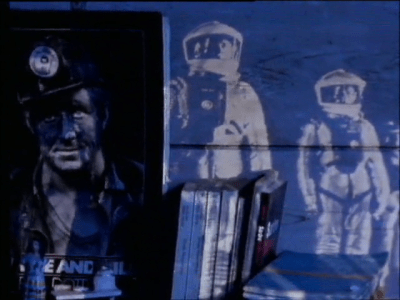
At the same time, Karlin is searching carefully for the future among these remains. His camera takes careful concerns with the frenetic activity of everyday life, whether it be the casual socializing of women in a laundromat, or the impersonal whirring of an automated assembly line. There’s a quiet excitement the unexpected futurism in some the images. A glowing photograph of astronauts is projected onto a poster showing a grubbied mining worker, for instance. Though anxieties about the future come up throughout the interviews, they speaks as often about how we can continue to change the world.
Karlin allows his interviewees tremendous space to articulate their experience and analysis. They are placed very effectively in the quiet atmosphere, inviting an attentive and sensitive approach to their varying experiences. Ambalavaner Sivanandan provides a subtle and wide-ranging assessment of racism and political economy, and David Widgery speaks movingly about his experience as a doctor and political organizer.
There is no reduction here of a worker’s perspective to a single, authentic voice. Socialism exists at once in the Darfield Community Action Group, and feminist academia, in all their resonance and difference. Still, the editing also finds symmetry between moments: there are two memorial services which invite comparison, for instance, and repeated motifs like the sideways glide across static architecture.
The film is contemplative, bringing us to utopia slowly and furtively. (It makes a refreshing change of pace for anyone accommodated to the frenetic output of Youtube video essayists.) Its understated movement combined with a fiercely political outlook make for a complex pace and tone. It’s deeply concerned with the unsettling emptiness and exhaustion of neoliberal Britain; at the same time, it lingers in the pervasive fog which seems to indicate movement, transformation among the rubble. Karlin plays subtly with the depth and shallowness of images, in projection, sculpture and montage, and gives respectful space to a range of vital political perspectives. There is still a quiet glow in the world Karlin depicts, which could relight the world if we tend to it.
JN Hoad

 Eve of the Future