CN: racism, sexual violence, trauma. This piece spoils key, late plot points from Twin Peaks: Tbe Return.
Approaching two years after the run of Twin Peaks: the Return, it’s hard to look back on the whole of the 18-hour cinematic TV piece with a feeling of satisfaction. This not because, for this critic, the series failed to be moving, distinctive or memorable. Just the opposite: the effect the show on myself and the hyper-engaged fandom it seemed mostly to be written for was potent. Its potency was in the careful but harsh feeling of deflation which it provoked. Those who sat through the entire eighteen hour run will understand what this disappointment is.
The show was, clearly, about absence as much as return. Its critical approach entailed drawing the audience towards our object of desire and fantasy precisely to disaffirm them, to show they were hollow, even horrifying.
This void appeared in multiple forms throughout the show. As the cryptic plot mechanics of the series unfolded, one character in particular became the figure of this unnerving lack: Diane. That the mystery of the show should become (mis)directed towards a character completely absent in the original run of the series is what interests me here.
Laura Dern’s portrayal of Diane became a distinctive point of attention for critical views on the show – political, polemical and conspiratorial – from the moment her presence in the new series was so much as hinted at. In particular, critics of colour have pointed to her as a manifestation of racist logic of Twin Peaksi. In particular, Penny Wang reads Diane’s stereotyped Asian counterpart Naido as an unsightly subaltern; the mute and blind Naido must be dismissed in order to the whitened Diane to emerge as Cooper’s true object of desire. The fact that Naido is silenced, speaking only in mumbled crackling, until she is spoken to and touched by a white man, is crucial here.
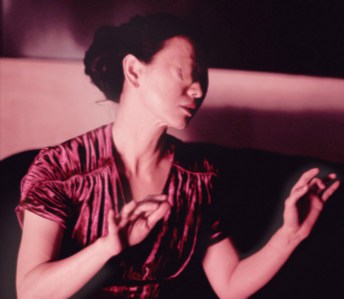
The long search for the ‘real’ Diane through this disturbing fantasy is, like much of The Return, a twisted reproduction of the logic of the original Twin Peaks. Diane does not appear in the original two series of Twin Peaks, except in the form of Agent Cooper’s tape recorder. One the many quirky Cooperisms repeated by fans and cosplayers is his frequent, chirpy commentaries on the unfolding enigma of Twin Peaks, addressed always to his unseen secretary at headquarters. A recording of Cooper’s tapes to Diane was even released so that we too could have the fun of piecing together the Agent’s running commentary. (In a sense, this release had the reverse of effect of Jennifer Lynch’s novelisation pf Laura Pamler’s diary, which gave voice the the otherwise absent subject of Twin Peak’s central mystery.)
In both her original, silent presence off-screen, and her final reveal in the form of a colourfullly wigged Laura Dern, Diane has been the subject of much speculation by fans. In the 90s, fans question exactly what Cooper’s relation with Diane was. Was she a potential crush for the otherwise morally chaste (yet charismatic and enticing) Cooper? What insight did she hold in receiving so many of the Blue Rose tapes? Meanwhile, the Diane of the Return became a frequent key piece in attempts to crack its intractable mystery. I remember as early as her first appearance, fans were playing on the near miss anagram of Naido/Diane to connect the two characters.
The manifestation of Diane as a tape recorder is what interests me here. Providing Agent Cooper with a tape-recorder to which he addresses his thoughts and feelings was an inventive way to get more out of Cooper’s rich inner life. It portrayed Cooper at once as a well-equipped professional and idiosyncratically sensitive.
In the twenty years since, the experience of having a handheld recording device which blankly and obediently listens to our every passing thoughts, notes and requests has become familiar. In a recent piece for Real Life Magazine, Meghan Gilligan has described the limited visual imagination of much contemporary film and TV in portraying smartphones. For Gilligan, this is symptomatic of the failure of nostalgia television and conventional drama to portray technological modernity; without texting, Instagram and Snapchat pings, visual media cannot properly situate our experience of modern culture.
The world of Twin Peaks seems to have developed this phobia of smartphones. Though we sit through many shots of characters sitting around listlessly, none of them browse Facebook. Only Cooper’s evil doppelganger (Mr. C) is strongly connected to phones. He uses a wired telephone to bring down a prison security system, and coordinates his various criminal and cosmic misdeeds through cryptic text messages.
The object of the smartphone is almost entirely excluded from The Return, but I hold the effect of the town technology maintain an estranged presence in the show. (One of the central images of its mysteries is a telephone poll after all.) Particularly, Diane could be read as a personification of the smartphone, in a development of Cooper’s tape recorder in the original series. (She was in this sense ‘manufactured for a purpose’.) The object which Cooper required to keep track of the unfolding mystery has become a central subject of that mystery. Diane was once cast as a silent witness to events, but seems through Dern’s performance to gain a body, presence, voice and agency.

We can trace the haunting, suggestive presence of handheld technology elsewhere in The Return. In Part 6, we meet Becky Burnett, the daughter of Bobby and Shelly Briggs. The most distinctive image we get of Becky is her face, in drug-fueled ecstasy, upturned in the passenger set of her boyfriend’s car, awash with a glow which seems to consume here. What does this picture of a young woman staring upwards in blank ecstasy with a glossy lighting filter overtop resemble more than a selfie?
As a character with an outwardly wholesome life, but who is deeply racked with relationship and drug issues, certain fans suggested Becky as a new Laura Palmer. Her role in the series turned out not to be so prominent, but it captures something about the changing visual imagination of the show. The image of Larua Pamler is her Prom Queen photograph, glossy in muted colours, smiling blankly just past the camera. The image has a unreal sheen to it, but the bulky frame and flat colours give it a physical presence in tun becomes suffuse with nostalgia. Beckie’s selfie is an image of the new Twin Peaks. The HD image is brightened to the point of being harsh, capturing us not with warm sentiment, but with a fleeting and ambivalence cold screen-glow.

Like the rest of The Return, the partial conclusion of Diane’s mystery offers no closure, and simply draws us further into the horror and confusion which the very instinct to investigate seems to conjure. In episode 16, the blonde Diane which we have followed with Gordon Cole and the gang in their attempt to track down the real Cooper is revealed to be a tulpa – a doppelganger manufactured in the Black Lodge to further the ends of Mr. C She is called upon to murder the FBI, but breaks down. More movingly, the scene becomes a piercing, cold portrayal of a woman confessing her experience of sexual violence: ‘I’m – I’m – I’m not’ me she stutters before anxiously confessing that Mr. C ‘raped’ her.
The figure who teased us from the edge of the narrative who once was simply an aspect of Cooper and the FBI’s quirky inscrutability is now implicated in the shows deepest evil, and herself a broken survivor of sexual violence. We can see this, then, as a characteristic manifestation of technology as absent nightmare in The Return: Diane goes form being a complacent technological counterpart to an entrapped ghost in the machinations of the Black Lodge.
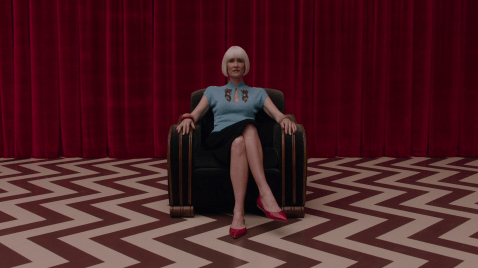
In this way, The Return disaffirms both our investments in its own narrative, and also the fantasies which surround contemporary visual and digital media. The digital assistant who lives in your smartphone is a key character in maintaining our mystified relationship with the capacities and importance of these gadgets. The fact that Microsoft has incorporated Cortana, the holographic assistant of the Halo series, into its interface indicates the appeal of the feminine digital assistant. The Start menu now invites you to tell the undulating circle which represents your new digital assistant your needs, entailing that this computersied pixie will conveniently sort them out for you.
James Ferraro has described the proliferation of these voice interfaces as part of a ‘disjunct vision of Silicon Valley to democratize the lifestyle of feudal lords and provide a middle class simulacrum via cheap automation and autistic AI assistants’. They simulate a particular experience in terms of class, gender and race. These figures (as I believe The Return can help us understand) are not absent sexual fantasy. The ghostly maiden in our smartphone is appealingly feminine, and visually represented in Cortana as curvaceous in a Tron-esque silicon leotard.
With Wang, we might also consider how this figures is racialisied. I suggest we could describe both Cortana, Diane and Naido as mukokuseki, a Japanese terms often used to describe ethnically ambiguous characters in anime. Literally meaning ‘nationless’, it indicates how anime artists are often unwilling to portray their characters readily as Japanese, and often obscure national and ethnic characters. Naido is literally whitened in the final moment The Return, indicating her existence in such ambiguous racial logic.
In turn, I argue that The Return displaces the fantasies which surround the digital assistant onto Diane. And, expressing the central logic of the series, these fantasies are in turn collapsed by her full revelation. We never see the full body of the AI assistant (and Cortana is represent simply a circle in the Microsoft interface). The laboring body of the electric maiden isn’t what we want – simply the willing voice and instantaneous results. Diane’s body, however, is much as issue in The Return. She is disguised, cloned, raped, and shot. This is the dragged body of the digital phantoms we seek to capture and subdue.
The Return in this way traverses the fantasy of the digital assistant through her absent embodiment. The voiceless, responsive woman who is always at our fingertips to take our notes, search Google, translate our words, is suddenly brought to life. This Pygmalion myth ends without satisfaction however. We are left with the simulated subaltern, injured and afraid, uncertain of our how we are implicated through our indulgence. The Return does not articulate a full critique of much of its subject matter, but the shocking effect of some of its imagery points towards an imaginary address to some of the dilemmas of desire. Diane as the figure who can record, edit and resolve the fragmented mystery of our desire is indeed absent, and we should be wary of seeking out a substitute: ‘Cut along the length but you can’t get the feeling back/She’s gone, she’s gone, she’s gone away…’
JN Hoad
i On race in Lynch’s work, see also Frank Guan’s piece for Vulture. Niela Orr also published a thorough discussion of Lynch’s representation of black characters towards in the early days of The Return‘s run.

 Eve of the Future